GBSD board meeting — May 7, 2026

GBSD is cutting elementary music from every K-5 school and permanently damaging all K-12 programs.

The proposed budget eliminates classroom music in all ten Gresham-Barlow elementary schools. That single decision will collapse middle school band and choir within two years and gut high school ensembles within five! Ending sixty-plus years of K-12 musical excellence in our district.

10 elementary schools affected24 programs in the pipeline including elementary schoolsK through 12

Voices from GBSD

Why elementary music matters.

K–5 music education holds a unique place in our schools: while middle and high school music programs reach only the students who choose them, elementary music is universal — every child participates. That makes those early years our one guaranteed window to give every student a foundation in music, regardless of background, family resources, or whether they ever pick up an instrument again. Skip it at the K–5 level, and for many kids, the door simply never opens.

The stakes go well beyond music itself. The elementary years are a critical period for brain development, and music engages this process in ways few other subjects can. It strengthens the neural pathways tied to language acquisition, memory, pattern recognition, and auditory processing — wiring that is far harder to build later in life. Without consistent music instruction during these formative years, children miss out on developmental gains the brain is specifically primed to make. Music isn't an extra or an enrichment activity at the K–5 level; it's a core subject that helps every other subject work better.
The numbers behind the K-5 cut

Performing arts in GBSD are not a small program — and the damage from cutting at the foundation does not stay at the foundation.

9

Elementary schools losing music

Every K-5 building in GBSD

~4,500

K-5 students affected

10 Elementary Schools District Wide

60+

Years of K-12 music tradition at stake

Including success prior to the formation of the Gresham-Barlow School District in 1994.

9

Middle school programs downstream

All GBSD middle school bands & choirs depend on K-5 feeders

8+

High school ensembles at risk within 5 years

Gresham , Sam Barlow, and Springwater Trail combined

K-12

Oregon requirement

State law requires music instruction at all grade levels

District-wide impact

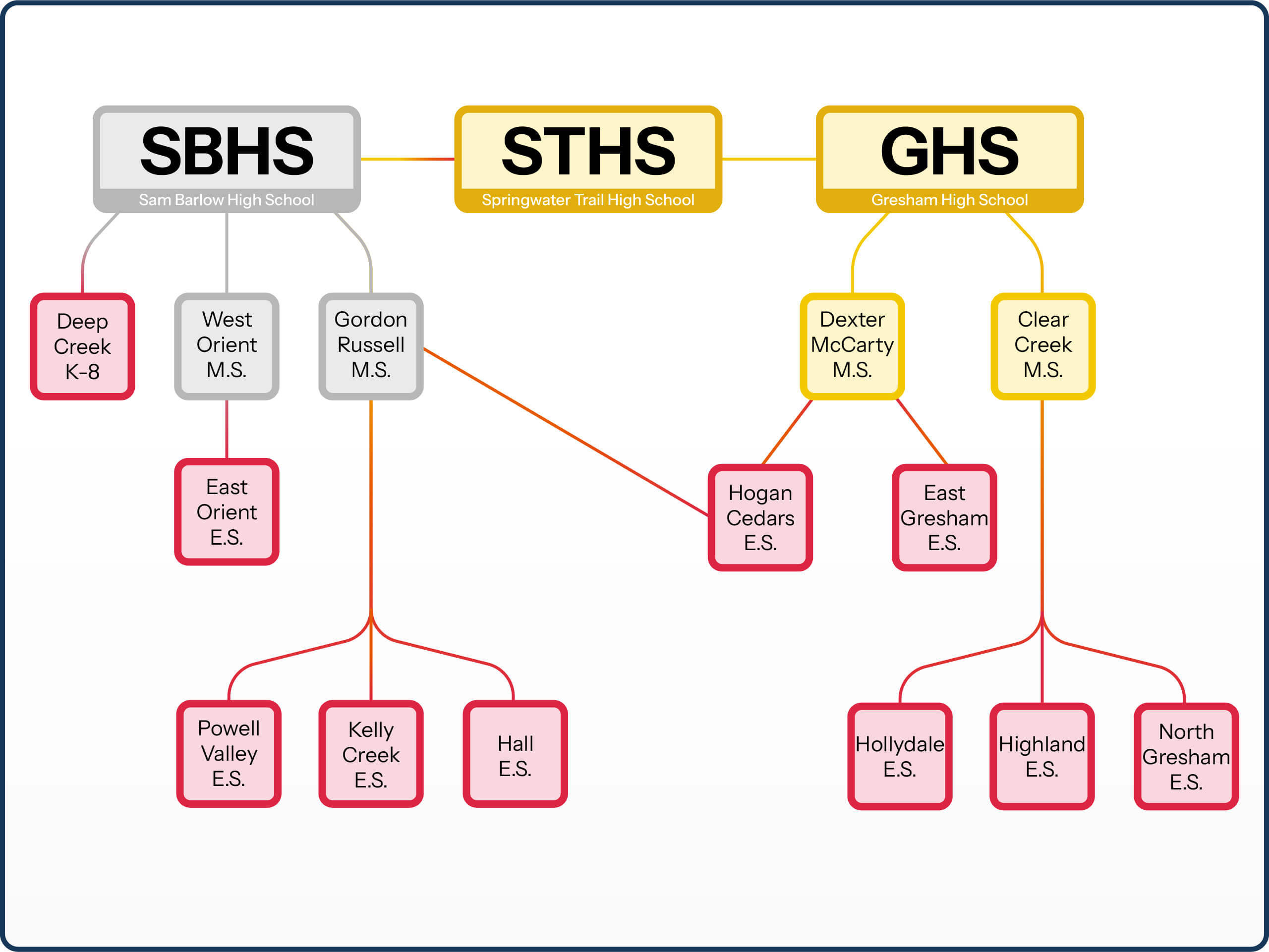
Not just K-5 — many schools are affected.

Job cuts at the elementary level displace less-senior secondary teachers. While they are all certified and trained music educators, elementary instruction and high school jazz band require very different areas of expertise.

Map of Gresham-Barlow schools affected by the proposed cuts

The ripple effect

Cut the Program of Study, the whole pipeline collapses.

This is not "just elementary." The K-12 music journey is one interlocking program. Eliminating K-5 music sets off a five-year cascade that ends with no competitive performing arts programs in any GBSD high school.

  1. Year 0 — the cut

    Elementary music eliminated district-wide

    Every K-5 student in all 10 GBSD elementary schools loses weekly music instruction taught by a certified, licensed and music endorsed educator.

    • ~4,500 K-5 students lose classroom music
    • 9 elementary buildings lose their music teacher
    • No on-ramp into the K-12 pipeline
  2. Year 1–2

    6th-grade band & choir enrollment collapses

    Incoming sixth graders arrive with no foundation. Beginning ensembles cannot move at the pace they used to, and most students drop out before the first concert.

    • Beginning band sign-ups projected to drop sharply
    • Sixth-grade choir loses singers who never built confidence
    • Directors spend the year teaching foundational music knowledge and skills that should already be in place
  3. Year 2–4

    Middle school programs shrink past the point of viability

    Without a steady feeder, advanced and symphonic ensembles at all 5 GBSD middle schools cannot fill themselves. Multi-period music programs collapse to single periods.

    • Advanced and intermediate bands consolidate or close
    • Treble and advanced choirs lose the prerequisite skills
    • Without full time jobs, it will be hard to keep highly qualified educators
    • Turn overs in Middle Schools will cause students to quit music programs
  4. Year 3–5

    High school ensembles lose their pipeline

    GHS & SBHS Wind Ensembles, Concert Choirs, Advanced Jazz bands, and other programs cannot fill auditioned seats. The full K-12 arts pathway is no longer viable.

    • Auditioned ensembles cannot meet roster minimums
    • Performing Arts pathway weakens at the high school level
    • 40+ years of GBSD music tradition becomes unrecoverable
  5. Year 5+

    A generation of GBSD students grows up without music

    Once dismantled, K-12 music infrastructure cannot be rebuilt in a single budget cycle. Restoring it requires hiring teachers, retraining educators, and rebuilding feeder culture from scratch — over a decade.

    • No realistic path back within 10 years
    • Multiple high schools without competitive performing arts
    • East-county families lose the only music access many can afford

The petition

Add your name on Change.org.

The official coalition petition lives on Change.org. Signing takes 30 seconds. Forward it after.

Open the petition

The legal question

Oregon law requires arts education — including music — at every grade level.

We believe a district-wide elimination of elementary music may not be lawful under Oregon's standards for public K-12 instruction. The coalition is reviewing the district's plan against state requirements. The relevant law is short, and it is plain.

ORS 329.045

Districts must offer arts instruction.

ORS 329.045 establishes that:

  • "School districts and public charter schools must offer students instruction in… the arts."
  • That instruction must "meet the academic content standards [for these subjects] adopted by the State Board of Education."
OAR 581-022-2030

The instructional program must be K-12.

OAR 581-022-2030 establishes that schools must offer a "planned K-12 instructional program [that includes the] Common Curriculum Goals and academic content standards adopted by the State Board of Education."

Under OAR 581-021-0200, the Common Curriculum Goals consist in part of the Common Knowledge and Skills — "facts, concepts, principles, rules, procedures, and methods of inquiry associated with subject matter areas including music and art."

The State Board's adopted arts content standards cover five content areas:

DanceMedia ArtsMusicTheatreVisual Arts

What this means for the proposed cut

  • ORS 329.045 obligates GBSD to offer arts instruction — and to meet the State Board's content standards for it. The State Board's standards explicitly include Music as one of five arts content areas.
  • OAR 581-022-2030 requires a planned K-12 instructional program — not a 6-12 program, not a high-school-only program. Eliminating music in all nine K-5 buildings removes K-5 from the planned program entirely.
  • The district has not, to our knowledge, published a plan describing how it will meet ORS 329.045 and OAR 581-022-2030 for K-5 music if classroom instruction is eliminated.

This site is not legal advice. We are flagging a compliance question we believe the board, district counsel, and the public should address on the record before any vote.

Read it for yourself

The OMEA's full write-up of the relevant statute and rule, with citations, is here:

Open the legal brief

Citations: ORS 329.045 · OAR 581-022-2030 · OAR 581-021-0200

There are other ways to balance this budget

Cutting K-5 music is a choice, not a necessity.

The coalition is compiling alternatives that preserve performing arts while still closing the budget gap. These are starting points — placeholders below will be replaced with specific figures and proposals as we gather them.

Option A

50% Music Reduction

Restore 50% of Elementary Music Educators and each teaches .5 in 2 elementary schools.

Allows for a music offering at each elementary taught by a licensed and highly qualified educator in Music Education.

Option B

Administrative & central-office review

small percentage reductions in non-classroom spending typically cover programs of this scale.

Option C

State funding & Student Investment Account (SIA)

[PLACEHOLDER: GBSD's current SIA / Measure 98 / Student Success Act allocation, and whether arts can be eligible uses] — a portion of these state funds is intended for well-rounded education, which explicitly includes the arts.

Option D

Community partnerships & private support

[PLACEHOLDER: foundations, corporate sponsors, or partner organizations that have indicated interest in K-5 music in GBSD] — bridge funding while the district develops a permanent plan.

Option E

Phased reduction with state-compliance review

Pause the proposed cut for one budget cycle. Commission an independent compliance review against Oregon's K-12 instruction requirements, publish the findings, and bring a revised proposal to the community before any reduction takes effect.

Have a budget alternative we should add?

The coalition is collecting proposals. Send specifics to replace@this.com — include the source of the figure or quote.

The board meets May 7.

Whatever we want them to hear, they need to hear it before then. Sign on Change.org. Email the board. Show up to public comment.

GBSave GBSD Performing Arts

A grassroots coalition of GBSD students, parents, teachers, alumni, and community members fighting the proposed cut to elementary music — and the downstream collapse of K-12 performing arts.

This site does not collect any personal information from public visitors.

Get involved

About

This site is run by community volunteers. It is not affiliated with the Gresham-Barlow School District.

© 2026 Save GBSD Performing Arts coalition.